Abstract
The opportunity for shopping malls is larger than replacing vacant stores with new tenants. A shopping center can become an integrated family destination that combines physical entertainment, children's development, social connection, dining, celebrations, and continuous programming. This article proposes three complementary demand engines: entertainment creates destination trips, enrichment creates recurring weekday routines, and events introduce new audiences and reasons to return. It connects recent retail and afterschool research with the author's work on the FEC Gap, Dual-Loyalty Model, Novelty Decay, Progression Gap, and whole-family value. The key argument is that family-oriented redevelopment must be planned and evaluated as a center-wide experience system, rather than a collection of unrelated attractions.
In brief
- Family entertainment gives households experiences that cannot be fully replaced by online shopping and creates new potential uses for large vacant retail spaces.
- Children's classes, clubs, camps, and workshops can generate predictable weekday visits, especially when families can coordinate several needs in one destination.
- Large events create discovery; daily and weekly programming creates habit. Participatory formats are more promising than disconnected promotional booths.
- Repeat visitation depends on more than equipment. Children need novelty and progress; parents need safety, convenience, comfort, and recognizable value.
- A shared calendar, family passport, cross-promotions, and eventually optional digital continuity can connect attractions, education, food, and retail without replacing each tenant's systems.
- Attendance, dwell time, cross-shopping, retention, event economics, and community reach must be measured separately. More visitors do not automatically mean more tenant sales.
The mall's new role in family life
Shopping malls were designed primarily to bring retailers and shoppers together. But families do not make decisions only about what to buy. They decide where to spend an afternoon, celebrate a birthday, enroll a child in a class, meet friends, eat together, and discover something new. Online retail can substitute for many transactions; it cannot fully substitute for physical play, hands-on experimentation, a live competition, or being part of a local community.
The 2026 ICSC Family-Focused Retail study provides a useful starting point. Among the parents and guardians surveyed, 57% reported visiting a shopping center or retail district with children at least weekly and 95% at least monthly. Among surveyed parents who visit those destinations, 86% said family-friendly experiences influenced where they shop. Across the sample, 79% said regular family-oriented events or activities would make them more likely to visit. These are reported behaviors and attitudes from a particular survey sample, not guarantees of incremental visits or sales for any individual property.
The same research offers an important warning: families care about affordability and convenience as much as entertainment. Affordable prices were the most frequently selected feature making a shopping center appealing for a family visit. A property cannot become a genuine family destination if the activities are exciting but the total trip is too expensive, difficult, uncomfortable, or impractical.
The strategic question is therefore not simply, What new attraction can fill this space? It is, How can the entire shopping center become part of a family's recurring life?
Three complementary engines of family traffic
1. Family entertainment: a destination reason to visit
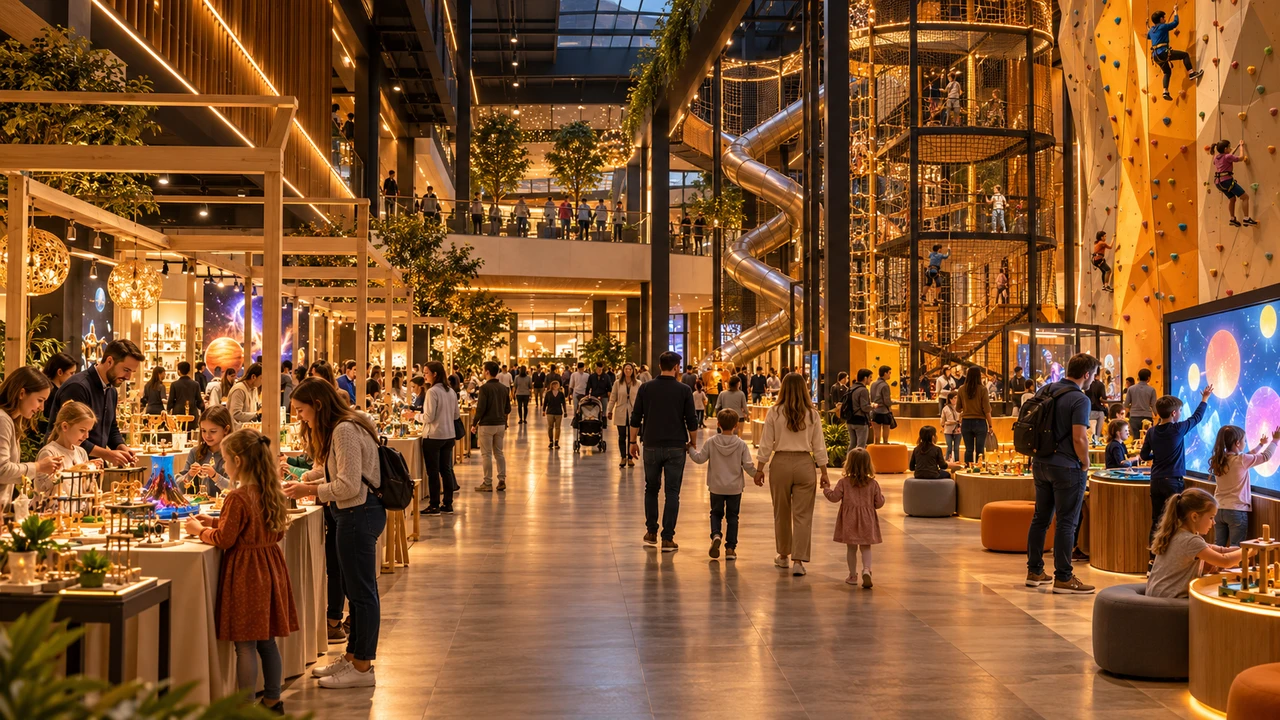
Family entertainment centers, indoor playgrounds, climbing and ropes courses, interactive attractions, sports challenges, creative play environments, and birthday venues can repurpose large spaces that are difficult to fill with conventional retail. An attraction may generate a trip that would not otherwise occur, bring children and accompanying adults to the property, and create opportunities for food, services, and other tenants.
The attractions industry has documented this role in mall repositioning, including in IAAPA's review of attractions in shopping malls. But the most useful distinction is between an entertainment tenant and a coordinated entertainment district. A single attraction can be successful while the rest of the center receives little benefit. A stronger approach combines complementary formats for different ages, clearly connects them to dining and other retail, and offers reasons to stay beyond the initial admission.
The mix matters. Younger children may need safe, imaginative, sensory, and physical play. Older children may seek climbing, challenge, strategy, autonomy, friends, and visible accomplishments. Families with children of different ages need a workable itinerary rather than an awkward choice between venues. Birthday celebrations, group bookings, camps, and school visits add further trip purposes.
The attraction itself must also evolve. A ropes course can introduce changing routes, precision tasks, team missions, seasonal competitions, and new levels without changing the entire physical installation. This is the difference between investing only in equipment and investing in a renewable experience.
2. Children's development and enrichment: a reason to come every week
Mathematics, reading, coding, robotics, science, chess, languages, art, music, dance, sports, entrepreneurship, and maker activities already occupy a significant place in many families' weekly calendars. Locating several complementary providers in one shopping center can make these trips easier. A family might combine a class, a meal, a library-style activity, shopping, and another child's program in a single visit.
The opportunity is supported by an access gap, although it should not be mistaken for proof of demand at every property. The Afterschool Alliance's 2025 America After 3PM research found that parents of nearly 30 million U.S. children wanted afterschool programs, while about 77% of that potential demand was unmet. Cost, transportation, inconvenient locations, and limited availability were major barriers. In its 2026 STEM report, 65% of parents whose children were in afterschool programs valued STEM opportunities when selecting a program.
This suggests a practical real estate strategy: test accessible clusters of classrooms, studios, clubs, and workshops in suitable smaller vacant spaces. Coordinate timetables so siblings can attend nearby programs, and give parents safe, comfortable options for waiting, dining, working, or completing errands. Weekday afternoons, evenings, school breaks, and camps can complement the weekend-heavy demand of entertainment anchors.
Development should not become a pretext for making every leisure activity feel like school. The best experience allows children to learn through making, moving, solving, creating, and collaborating. Value is stronger when children enjoy the activity and parents can see why it matters.
3. Large events and continuous programming: new audiences and new stories
Family Expos, Children's Business Fairs, science festivals, robotics demonstrations, makers' markets, performances, competitions, school showcases, family challenges, and community celebrations give people reasons to visit beyond ordinary shopping. They also connect the property to schools, youth organizations, artists, clubs, small businesses, and local residents.
The most effective events invite participation. In a study of 280 participants at shopping mall events, Sit and Birch (2014) found that an actively engaged audience segment reported longer stays, more shopping and food purchases, more sharing, and stronger intentions to attend similar events than a more passive segment. This is observational evidence, not a guarantee, but it provides a good design principle: let visitors build, compete, demonstrate, discover, and take part rather than only watch or collect promotional materials.
An event calendar should operate on several time horizons:
- Annual or seasonal: signature festivals, major expos, holiday celebrations, and competitions generate regional attention.
- Monthly: rotating science, art, entrepreneurship, and challenge themes introduce novelty.
- Weekly: recurring family fairs, clubs, tournaments, workshops, and performances build routines.
- Daily or hourly in active zones: demonstrations, micro-challenges, story sessions, creative activities, and short performances keep the environment alive.
An event every weekend and activity every day is a useful planning ambition for a suitably sized and resourced destination, not an inflexible rule for every property. Organizers should consider staffing, safety, capacity, noise, clean-up, and tenant disruption. Sponsorship, exhibitor participation, paid workshops, and partnerships can offset event costs; whether a particular event breaks even must be established from its full economics.
The marketing value can extend beyond attendees. Event listings, local calendars, parent newsletters, school communications, community media, and partner networks repeatedly associate the shopping center with relevant family experiences. Consistent programming can help turn a retail address into a recognizable part of community life.
From separate attractions to a connected family experience
The three engines work best when they are connected. Entertainment attracts a destination visit. Enrichment gives a household a scheduled reason to return. Events create discovery and public attention. Dining, convenience, parent amenities, and thoughtful circulation allow the different purposes to reinforce one another.
A center-wide plan can organize space into complementary roles:
- Larger anchor spaces: multi-age family entertainment, celebrations, group activities, and major indoor attractions.
- Smaller stores and studios: developmental classes, creative workshops, clubs, and flexible learning rooms.
- Common areas: short discovery activities, temporary showcases, safe play points, wayfinding, and event activation.
- Food and social areas: family meals, snacks, adult-friendly seating, work-friendly corners, and informal gathering places.
- Flexible event space: expos, performances, contests, school exhibitions, seasonal installations, and maker fairs.
Physical connections matter. Visible activity can invite discovery, but an attraction's entrance, location, sightlines, pedestrian paths, nearby cafés, and promotional connections determine whether people explore other parts of the property. A destination entrance and a gallery-facing entrance may serve different needs: one supports planned arrivals and group bookings, while the other encourages discovery by existing shoppers. Both must meet operating and safety requirements.
Small, free, rotating discovery points can introduce the family offer without substituting for the main attractions. A brief challenge, interactive installation, or children's creation display may help a family understand what is available elsewhere in the center. Such points require accessibility, supervision rules, hygiene, suitable placement, and clear separation from circulation hazards.
Why families return: six lessons from FEC research
The author's FEC Gap framework argues that a venue should be evaluated as a complete experience system, not simply by the number of attractions it contains. This has six especially important implications for shopping malls.
First, loyalty belongs to both the child and the parent. The Dual-Loyalty Model distinguishes a child's enthusiasm from a parent's approval. Children may seek excitement, freedom, friends, and challenge. Parents assess safety, cleanliness, convenience, total cost, food, comfort, and developmental value. A durable family destination has to earn both decisions.
Second, physical durability is not the same as psychological novelty. In Novelty Decay, an attraction can remain operationally sound while becoming familiar to repeat visitors. New missions, monthly themes, cooperative games, varied difficulty, and recognition can refresh the experience without requiring constant replacement of expensive equipment.
Third, repetition should become progression. The Progression Gap describes what happens when every visit starts from zero. A child can return to improve a climbing time, complete a robotics project, develop a new creative work, qualify for a tournament, or reach the next challenge level. The central test is simple: can visit five build on visits one through four?
Fourth, adults should have a real experience too. The Passive Parent Problem identifies the costs of asking parents only to pay, supervise, and wait. A center can give adults choices: participate, observe comfortably, work, relax, meet friends, or shop while children are engaged in appropriately supervised programs. The author's 2026 parent interviews similarly point to affordability, mixed-age compatibility, comfort, safety, and renewal as part of whole-family value. Those qualitative findings provide design hypotheses to test, not population-wide estimates.
Fifth, development creates a place in the weekly calendar. Mathematics, reading, coding, robotics, science, chess, art, music, and sports already shape many families’ routines. When children enjoy these activities and parents can see their progress, the destination offers a recurring purpose beyond an occasional leisure outing. Coordinated schedules, nearby programs for siblings, and convenient places for parents to wait can make weekly participation easier. These programs should respond to local family needs and remain enjoyable, accessible, and appropriately supervised.
Sixth, social connection gives families a reason to belong. Children may return to meet friends, work with a team, join a club, or prepare for a shared showcase or competition. Parents can also build relationships through recurring activities and community events. Familiar people, collaborative projects, and a dependable calendar can create continuity between visits. The destination becomes a place where families participate in an ongoing community, alongside the attractions and programs they enjoy.
Together, these principles shift the goal from selling another visit to creating an ongoing relationship with the household.
Digital continuity without unnecessary complexity
One practical way to connect the center is through a shared family calendar and, eventually, an optional family account. The first phase does not require a sophisticated application: a common event calendar, printable or QR-based family passport, partner referrals, birthday inquiries, and cross-promotional offers can already make a fragmented tenant mix easier to use.
Later phases may add coordinated reservations, multi-attraction offers, memberships, class bookings, saved achievements, and rewards. A child who completes a challenge, attends a workshop, or presents a project may receive a level, badge, or suggested next activity. Participating restaurants and retailers might offer clearly priced, voluntary rewards or joint packages. Each operator should retain responsibility for its own transactions, supervision, waivers, and safety-critical controls.
Technology should support a physical and social experience, not replace it with passive screen time. Parents should control consent and family profiles, public recognition should be optional, and children's information should be minimized and protected. The Family Entertainment Park of the Future applies the same principle within an individual venue: adaptive content, creative output, and progress matter more than futuristic decoration.
The economics: attendance is not enough
Entertainment can attract people and extend time on property, but incremental tenant spending is not automatic. A 2023 transaction-data study by Lee and colleagues found a negative association between movie attendance and subsequent spending in the retail categories it studied. It is a useful warning against treating every entertainment visit as a guaranteed cross-shopping benefit. Similarly, Placer.ai's 2026 tenant-mix analysis emphasizes that longer dwell time creates an opportunity for cross-shopping, not a direct measure of it.
Landlords and operators should therefore evaluate both customer outcomes and commercial outcomes:
- Incremental traffic: first-time and repeat visits, visitor origins, dayparts, and movement into underused parts of the property.
- Visit quality: length of stay, family satisfaction, parent and child feedback, accessibility, and reported reasons for visiting.
- Cross-shopping: participating tenant transactions, optional voucher redemption, dining conversion, and comparisons against baseline periods.
- Habit formation: class attendance, 30/60/90-day household return, membership retention, and progress through multi-visit challenges.
- Event performance: unique attendees, new-to-center households, qualified leads, earned publicity, sponsor and exhibitor revenue, staffing, cleaning, security, and net cost per acquired family.
- Community value: participation by schools, local organizations, young entrepreneurs, and families from different parts of the trade area.
Simple before-and-after comparisons can mislead because weather, holidays, promotions, school calendars, and tenant changes also affect traffic. Stronger evaluations compare similar days and periods, track program participants separately where consent permits, and test whether an observed improvement survives after the initial novelty of a launch.
A practical implementation sequence
1. Understand the family market. Start with trade-area data, visitor flows, age profiles, parent interviews, local schools and providers, current tenant performance, vacancies, and safety or accessibility constraints. Identify needs not being served and the dayparts where the property has room to grow.
2. Test the demand before committing to a full district. Run a participatory family event, a small series of workshops, and a recurring club or challenge. Use temporary space and simple registration to learn who arrives, what they do, what they value, and whether they return.
3. Build a complementary physical mix. Select entertainment, enrichment, dining, and event operators based on distinct customer missions rather than treating each vacancy as a separate leasing problem. Design visibility, wayfinding, shared amenities, and a coordinated timetable from the outset.
4. Add continuity and measure it. Publish an ongoing calendar, introduce optional passports or memberships, coordinate partner offers, and follow repeat households and tenant outcomes over time. Expand only the elements that demonstrate family value and sustainable economics.
The implementation should respect lease rights, life-safety rules, capacity, accessibility, insurance, noise, traffic management, privacy, and the economics of each independent operator. A shared destination strategy does not mean one entity must own every activity.
Conclusion
The next generation of shopping malls does not need to abandon retail. It needs to connect retail with more of the activities that bring families together. Entertainment can create destination trips. Developmental programs can build weekday routines. Events can bring new audiences, local visibility, and community participation. Food, comfort, accessible pricing, coordinated operations, and a continuing family journey can connect these individual reasons into something larger.
The goal is not simply to fill empty spaces. It is to create a place where families choose to arrive, stay, participate, return, and recommend. The most promising shopping center is not only a collection of tenants. It is an evolving part of family life.
References
- ICSC Insights & Intelligence (2026). Family-Focused Retail: How Families Balance Spending, Value and Experience Across Retail Destinations. Survey conducted June 2026.
- Afterschool Alliance (2025). Lost Opportunity: Afterschool in Demand, But Out of Reach for Many.
- Afterschool Alliance (2026). Afterschool STEM Takes Off.
- IAAPA (2024). How Attractions Are Resurrecting Shopping Malls.
- Sit, J. K., & Birch, D. (2014). Entertainment events in shopping malls: Profiling passive and active participation behaviors. Journal of Consumer Behaviour, 13(6), 383–392.
- Lee, M., Cho, J., Kim, Y., & Kim, H.-J. (2023). Impact of movie-watching on cross-selling revenue in shopping malls: Implications for post-pandemic recovery. Journal of Retailing and Consumer Services, 73.
- Placer.ai (2026). The New Tenant Mix Playbook.
Related Articles
- The FEC Gap: What Family Entertainment Parks Leave Unresolved
- What Parents Want from Family Entertainment Centers: Beyond More Attractions
- The Dual-Loyalty Model
- Novelty Decay: Why Children Get Bored With the Same Family Entertainment Park
- The Progression Gap: Why Repeat Visits Should Build on What Came Before
- The Passive Parent Problem
- The Family Entertainment Park of the Future
- How to Build the Best Activity Park (full book)